
Telling time in Spanish asks a lot of a young learner. Read the clock. Recognize the numbers. Count by fives. Now do all of that in Spanish, with grammar that doesn’t match English.
That’s why kids get stuck. It’s not one skill. It’s three or four skills happening at once.
The fix is to pull those skills apart, teach them in a sensible order, and then give kids lots of hands-on practice putting them back together. This guide covers how to tell time in Spanish, the order I’d teach it in, and activities you can use at school or at home.
The Basics of Telling Time in Spanish
To ask the time, you say:
Qué hora es? (What time is it?)
For the answer, there’s one rule kids need to learn first:
- 1:00 → Es la una.
- Every other hour → Son las ___. (Son las dos. Son las tres. Son las diez.)
Why the difference? La una is one hour, so it’s singular. Every other number is plural. English doesn’t do this, so expect kids to say “son las una” for a while. That’s normal.
To add minutes, use y (and):
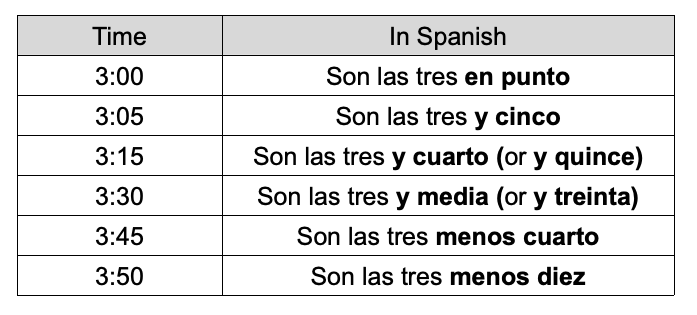
That last pair is the tricky one. After the half hour, many Spanish speakers count down to the next hour: 3:50 becomes “four minus ten.” In much of Latin America you’ll also hear Son diez para las cuatro or Faltan diez para las cuatro. Both are correct, and Son las tres y cincuenta is fine too, especially for beginners.
A few more phrases kids need:
- de la mañana / de la tarde / de la noche: in the morning / afternoon / at night
- Es mediodía: it’s noon
- Es medianoche: it’s midnight
- ¿A qué hora…?: At what time…? (¿A qué hora comes?)
- A las ___: at ___ o’clock (Como a las doce.)
Don’t skip ¿A qué hora? It’s how kids end up using time in real conversation, to talk about when things happen in their day.
Telling Time in Spanish Vocabulary (and the Numbers Kids Need)
Before the clock, make sure the basics are solid:
- Time words: la hora (hour), el minuto (minute), el segundo (second), el reloj (clock)
- Clock parts: las manecillas (the hands), la manecilla corta (the short hand), la manecilla larga (the long hand)
- Clock types: el reloj analógico and el reloj digital
- Numbers: 1–60, including skip counting by 5s and 10s
The numbers deserve the most attention. If a child still has to think hard about cuarenta y cinco, telling time will feel impossible. Short, playful number practice pays off here, and these Spanish number games are a good place to start.
Visuals help too. A clock poster with the numbers written in Spanish, or flashcards with an analog clock on one side and the words on the other, gives kids something to look back at. Here are some ways to use Spanish flashcards beyond the usual drill.
The Best Order for Teaching Telling Time in Spanish
This is where most of the frustration comes from: trying to teach everything at once. A clear sequence keeps it manageable.
- The hour. Es la una. Son las dos. Lock in the singular/plural rule before anything else.
- The half hour. Y media. One new phrase, and the clock still looks simple.
- Five-minute intervals. Now skip counting by fives starts to matter: y cinco, y diez, y veinte…
- Quarter hours. Y cuarto and menos cuarto.
- Counting down with menos. Save this for last. It requires thinking ahead to the next hour, which is a big jump.
Young learners (roughly K–1) usually live in steps 1 and 2 for a while. Steps 3 to 5 tend to fit 1st and 2nd grade and up. Don’t rush to menos. A child who’s confident with y has a strong foundation.
Start with a Song
A song is a low-pressure way to get ¿Qué hora es? into kids’ heads before any formal practice.
Rockalingua’s “¿Qué hora es?” is made for exactly this. It’s catchy and repetitive, and it models the question and answer pattern. Sing it a few times, then pause it and have kids show the time with their arms as clock hands.
Use it again at the start of each telling time lesson. It doubles as a quick warm-up.
Hands-On Activities for Telling Time in Spanish
Kids need to see the same time in three forms and connect them: an analog clock, a digital clock, and the words (son las tres y media). Most of the practice below does that in a different way. They also work well as learning center rotations, so kids meet the same skill several times without repeating the same task.
Matching the three forms
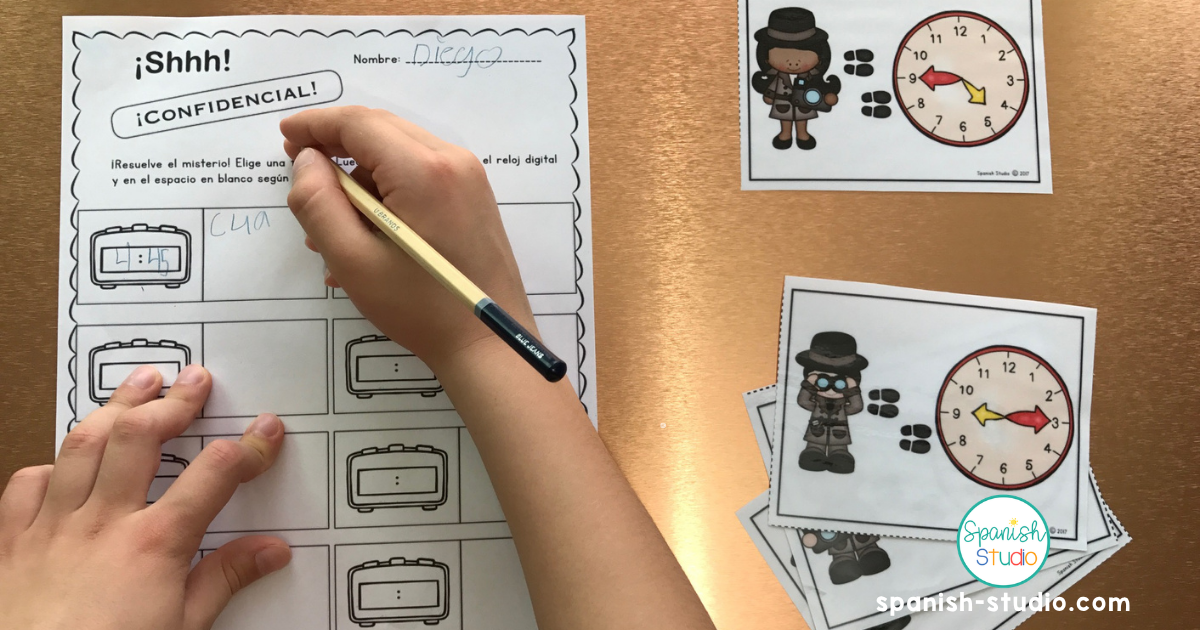
- Telling Time Detectives: kids pick a digital clock card, then draw the time on an analog clock and write it in words.
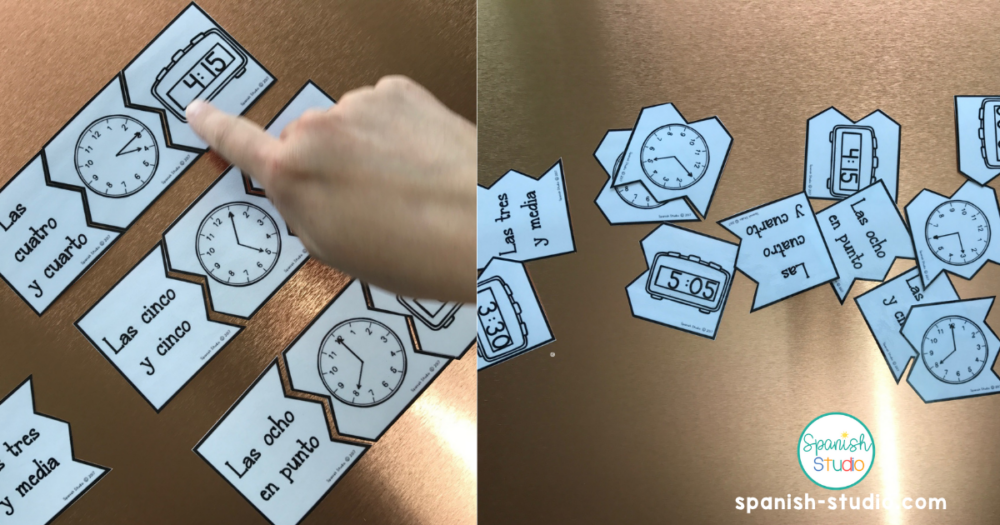
- Puzzles: three pieces (digital, analog, written) fit together. There’s a center version and a cut-and-glue worksheet version with two pieces.
- Picture–Word Match: match each clock to the correct phrase.
- Interactive Notebook: cut, sort, and glue each analog clock next to its digital match.
Building and drawing time
- Cut and Paste Clock: kids assemble their own clock. Keep it and use it for every other activity.
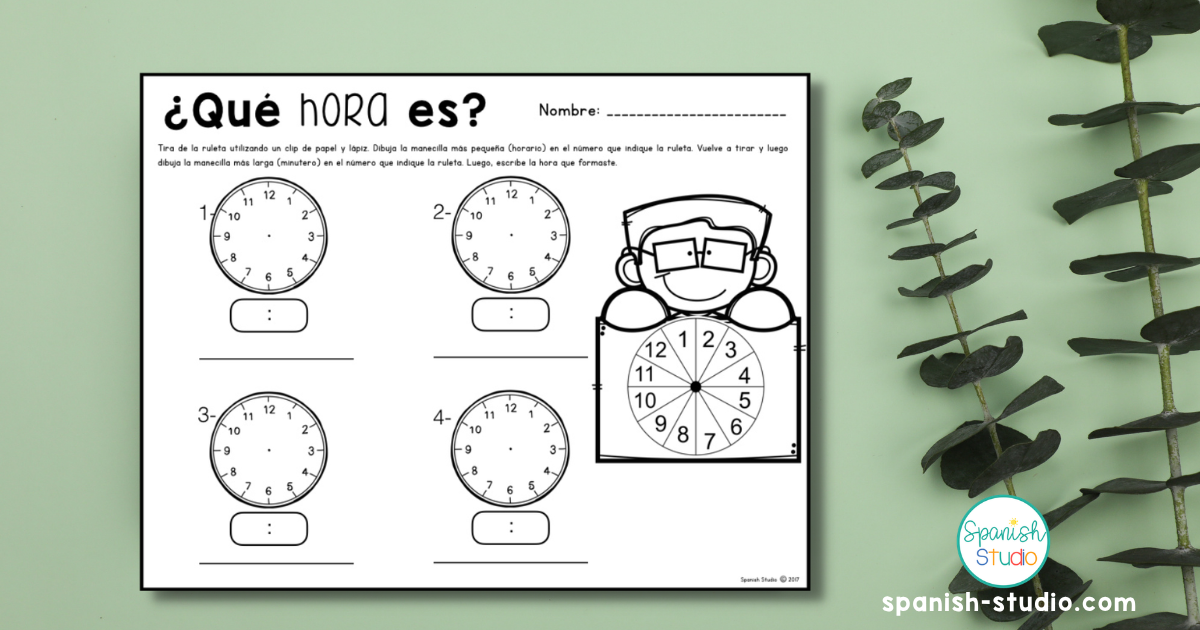
- Spin the Wheel (drawing): spin a number, draw the short and long hands on a clock, then write the time.
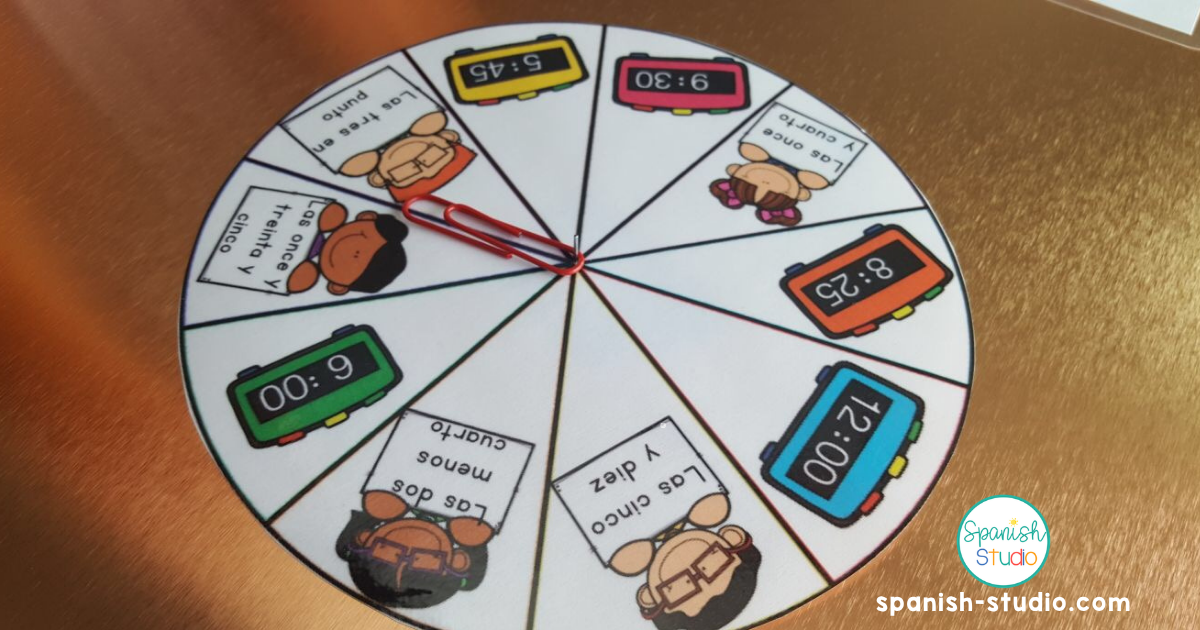
- Spin the Wheel (mat): spin, then cover the digital clock on the mat that matches the analog and written time on the wheel.
Games
- Memory / Find the Match: play classic memory, or hand out cards and have kids walk around to find the classmate with the same time.
- Tic-Tac-Toe: take turns covering the times; three in a row wins.
- Dominoes: each player gets five cards and matches times end to end. The first one out of cards wins.
Connecting time to real life
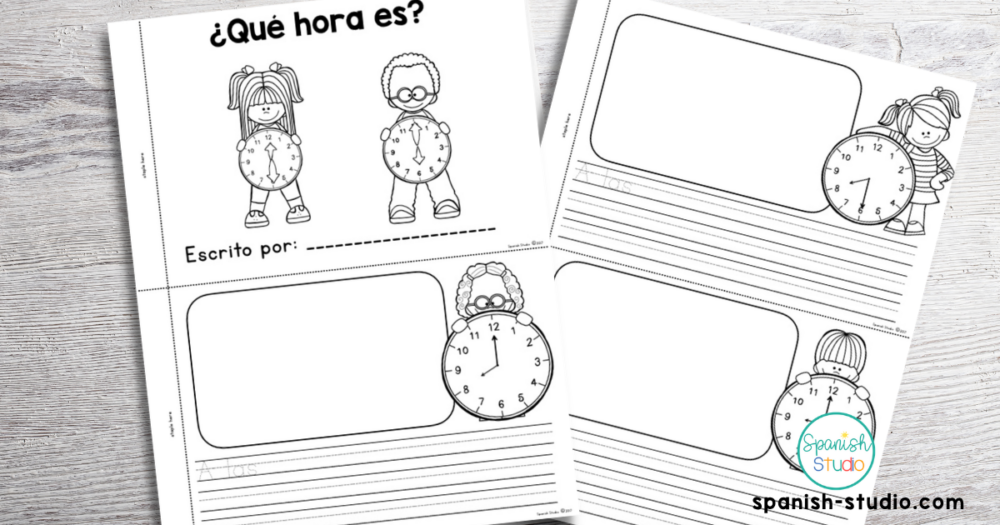
- Telling Time Mini Book: each page has a clock. Kids write what time it is and what they do at that time, then draw a picture.
The mini book matters more than it looks. It’s where Son las siete turns into A las siete desayuno. That’s the point where kids are using time in Spanish, not just reading clocks.
All of these activities come ready to print in my Telling Time in Spanish (Hour and Half-Hour) set for K–1 and my Telling Time in Spanish (Nearest 5 Minutes) set for 1st–2nd grade. Both follow the sequence above, and the Telling Time in Spanish BUNDLE includes both for less.
A Game That Needs Nothing: ¿Qué hora es, señor Lobo?
This is the Spanish version of “What Time Is It, Mr. Wolf?”
One child is el lobo and stands with their back to the group. Everyone calls out, “¿Qué hora es, señor Lobo?” The wolf answers with a time, like “Son las tres,” and the group takes that many steps forward. When the wolf shouts “¡Es la hora de comer!”, everyone runs back to the start before getting tagged.
Kids practice the question and answer pattern dozens of times without noticing. It works at recess, in the backyard, or in a gym.
Read a Story About Time
La mariquita malhumorada by Eric Carle (the Spanish edition of The Grouchy Ladybug) is built around the clock. Each page shows a clock face and a new hour as the ladybug picks fights all day.
While you read, stop and ask: ¿Qué hora es? Have kids show the time on their own paper clocks. Afterward, they can write their own version: A las seis, yo…
Make Time Part of the Day
This is the easiest practice of all, and the one families and teachers skip most often.
Post a daily schedule with times, and refer to it in Spanish: Son las diez. ¿Qué hacemos a las diez? At home, the same works for meals, bedtime, or leaving for school. A few times a day, every day, adds up fast.
If you want something ready to use, my Editable Daily Schedule Cards in Spanish work in a classroom or on the fridge.
Common Mistakes When Telling Time in Spanish
- “Son las una.” Remind kids: one hour, one es. Es la una.
- Leaving out “las.” “Son tres” sounds incomplete. The las refers to las horas, and it stays.
- Translating word for word. “It’s three o’clock” isn’t “Es tres o’clock.” It’s Son las tres (or Son las tres en punto).
- Forgetting that menos jumps ahead. At 3:45, the hour is cuatro, not tres. Have kids point to the next number on the clock before they answer.
- Mixing up “Son las” and “A las.” Son las dos means it’s two o’clock right now. A las dos means something happens at two.
Telling Time in Spanish: FAQs
How do you ask “What time is it?” in Spanish?
¿Qué hora es? In some places you’ll also hear ¿Qué horas son?, which is common in parts of Latin America.
Why is it “es la una” but “son las dos”?
One o’clock is a single hour, so it uses the singular es la. Every other hour is plural, so it uses son las.
Do I have to teach “menos”?
Not right away. Y treinta y cinco or y cincuenta is correct and easier for beginners. Introduce menos once kids are confident with y.
Do Spanish speakers use the 24-hour clock?
Often for schedules, like transportation, TV, and events. In everyday conversation, most people use the 12-hour clock with de la mañana, de la tarde, or de la noche.
What grade should kids learn to tell time in Spanish?
Hour and half-hour often start in kindergarten or 1st grade. Five-minute intervals usually come in 2nd grade, the same timeline as telling time in English.
Interested in more?
Download my FREE Guide: “Simple Ways to Teach Spanish Like a Pro (even if you don’t speak Spanish)”
Great Resources! n/a on website – I am just a parent trying to help high school freshman learn Spanish.
Thank you Kellie!!
hola me interesa el material
como puedo consegurlo ?
Hola!! Gracias por el interes. Directamente en la web o en mi tienda en Teachers Pay Teachers. Dejo el link: https://www.teacherspayteachers.com/Product/Telling-Time-in-Spanish-BUNDLE-3225290